Qualitative and quantitative research are not rivals; they answer different kinds of questions and are often strongest when used together.
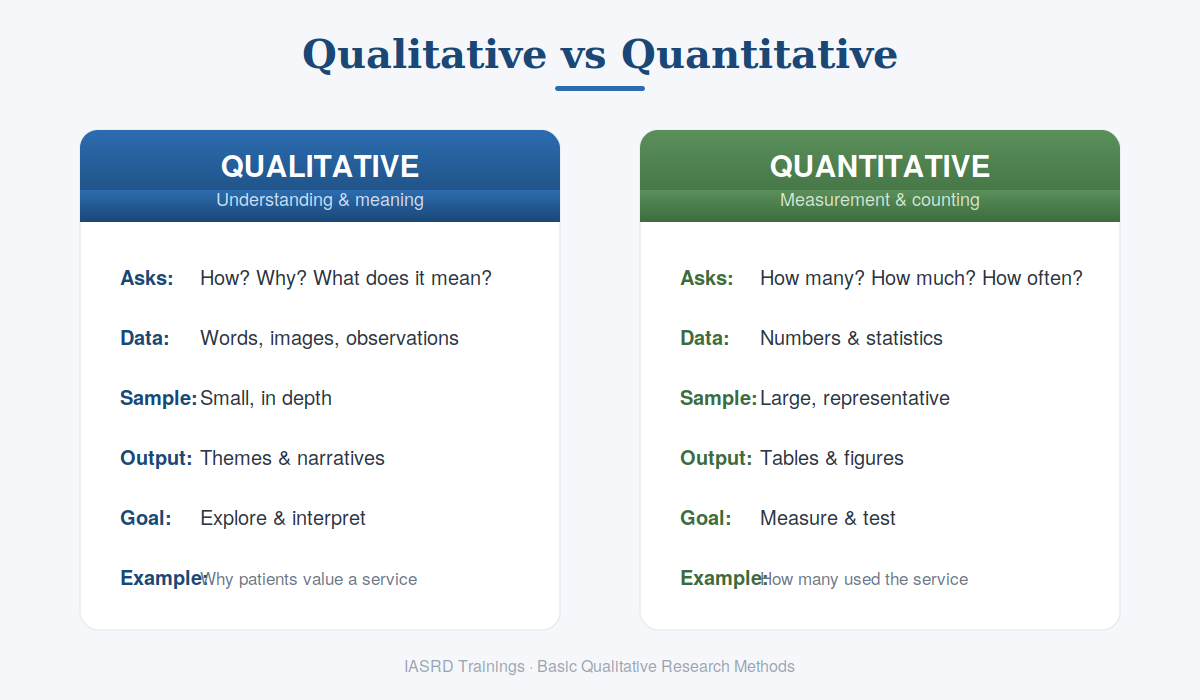
Quantitative research measures and counts. It tests hypotheses, looks for patterns across large samples, and expresses findings as statistics. It is well suited to questions about frequency, magnitude, and relationships between variables.
Qualitative research explores and interprets. It works with smaller numbers of participants in greater depth, and expresses findings as themes, narratives, and descriptions. It is well suited to questions about experience, meaning, and process.
A simple way to remember the difference:
– Quantitative asks: How many? How much? How often?
– Qualitative asks: How? Why? What does it mean?
Neither approach is superior. The right choice depends on the research question. A study counting how many people use a service is quantitative; a study exploring why they value it is qualitative. Many real-world projects combine both in what is called a mixed-methods design.
Key idea: Choose the approach that fits the question — not the other way around.