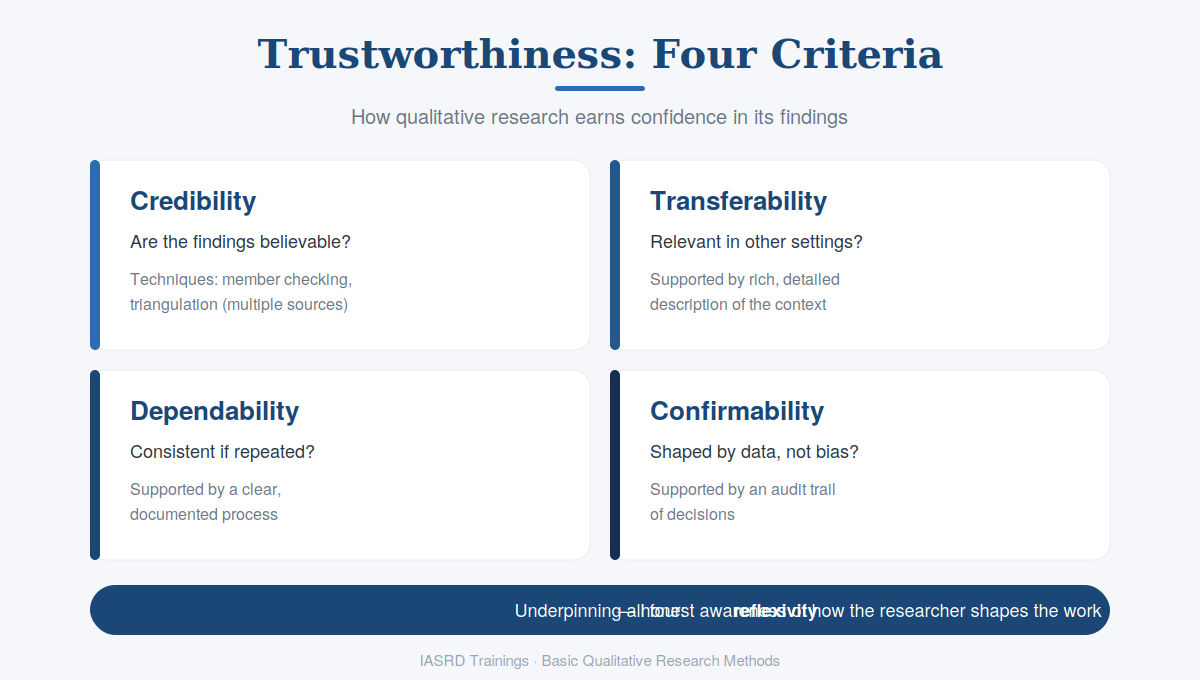
Qualitative research is judged not by statistical reliability but by its trustworthiness — whether the findings can be believed and are well grounded in the data. Four criteria are widely used.
Credibility — are the findings a believable interpretation of the data? Techniques include member checking (returning findings to participants) and triangulation (using more than one data source or method).
Transferability — could the findings be relevant in other settings? This is supported by rich, detailed description of the context.
Dependability — would the study produce consistent findings if repeated? A clear, documented process supports this.
Confirmability — are the findings shaped by the data rather than the researcher’s bias? An audit trail of decisions helps demonstrate this.
Central to all of these is reflexivity: the researcher’s honest awareness of how their own background, assumptions, and role shape the research. Far from a weakness, acknowledging this strengthens the work by making its perspective transparent.
Key idea: Trustworthy qualitative research is rigorous, transparent, and reflexive.