Several established designs guide how qualitative studies are planned and carried out. The most common include:
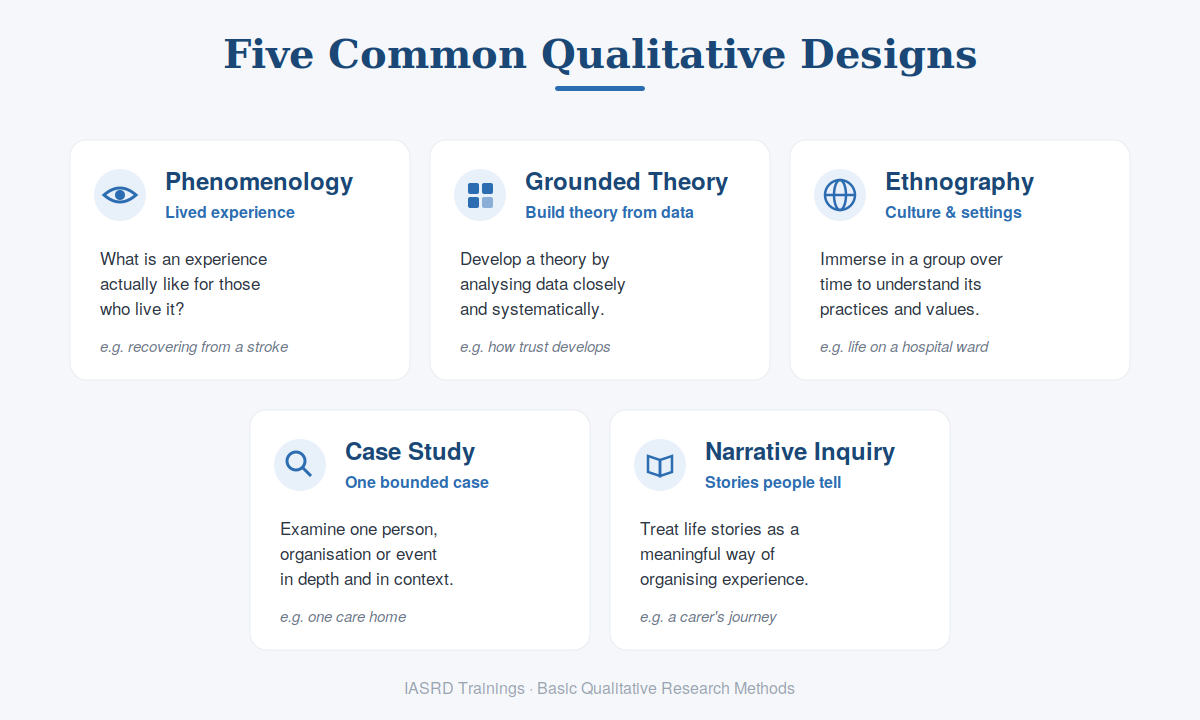
Phenomenology focuses on lived experience. It asks what an experience is actually like for those who live it — for example, the experience of recovering from a stroke.
Grounded theory aims to build theory from data. Instead of testing an existing theory, the researcher develops one by analysing data closely and systematically as it is collected.
Ethnography studies culture and social settings. The researcher immerses themselves in a community or group over time to understand its practices, values, and everyday life.
Case study examines one bounded case — a person, organisation, or event — in depth and from multiple angles to understand it fully in its real context.
Narrative inquiry centres on the stories people tell about their lives, treating those stories as a meaningful way of organising and communicating experience.
You do not need to master all of these at once. The important point is that a design gives your study a clear logic and shapes the decisions that follow.
Key idea: A design provides the underlying logic that connects your question to your methods.