Interviews are not the only way to gather qualitative data. Two other valuable methods are focus groups and observation.
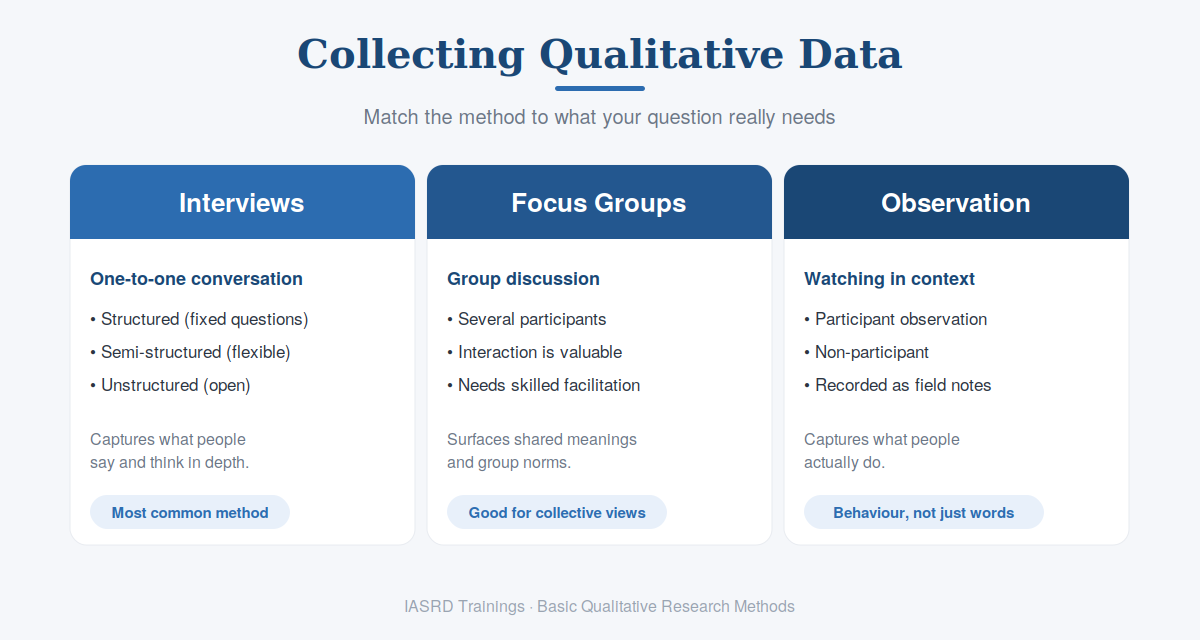
Focus groups bring several participants together to discuss a topic. The interaction between people is itself valuable — participants build on, challenge, and refine each other’s views, surfacing shared meanings and points of disagreement that might not emerge in a one-to-one interview. They are well suited to exploring group norms and collective experience, though they require skilled facilitation to keep discussion balanced.
Observation involves watching and recording behaviour in its natural setting. In participant observation, the researcher takes part in the activity being studied; in non-participant observation, they watch without taking part. Observation is powerful because it captures what people actually do, which may differ from what they say they do. Detailed field notes are the main record.
Choosing a method depends on your question: interviews and focus groups capture what people say and think, while observation captures what they do.
Key idea: Match the data collection method to what your question really needs.