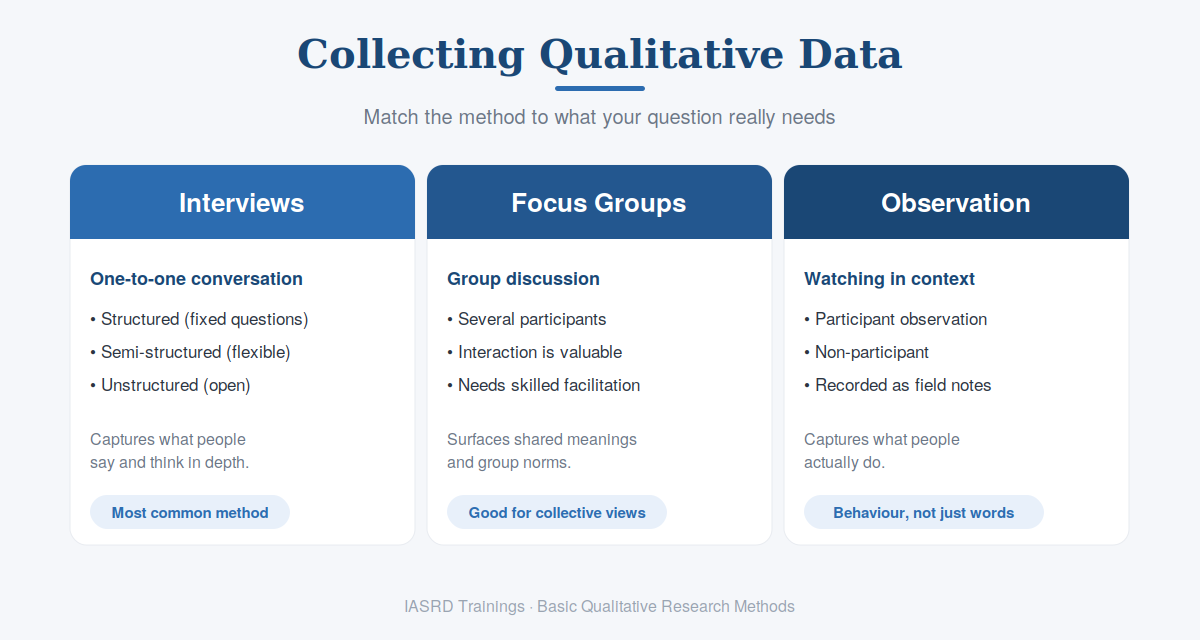
The interview is the most widely used qualitative method. It allows the researcher to explore a participant’s perspective in depth and to follow up on what they say.
Interviews vary in structure:
Structured interviews follow a fixed set of questions in a fixed order — closest to a spoken questionnaire.
Semi-structured interviews use a flexible guide of topics and questions but allow the conversation to develop naturally. This is the most common form in qualitative research.
Unstructured interviews are open and conversational, guided only by a broad topic.
Good interviewing is a skill. Strong practice includes asking open questions (“Can you tell me about…?”), listening more than talking, allowing silence so participants can think, and using gentle prompts (“Can you say more about that?”) to deepen responses.
Interviews are usually audio-recorded with consent and later transcribed so they can be analysed carefully.
Key idea: Semi-structured interviews balance focus with the freedom to explore.